






Quick answer: An emergency plumber in Midrand bills at the published R600-R1,300 per hour emergency rate, with local operators quoting about a 60-minute response target (burst-pipe arrivals within ~30 minutes in central Midrand). At least one operator publishes a flat R350 call-out fee. While you wait: isolate the water, kill power to anything wet, and photograph the damage for your insurer.
Burst pipe at 2 a.m. Geyser flooding the ceiling on a Sunday. Sewage rising in the floor drain while the kids are asleep. The difference between a contained incident and a water-damage claim is not the plumber's skill - it is the first ten minutes: what you shut off, what you photograph, and how fast a verified 24/7 operator is rolling. This is the complete emergency protocol for Midrand, built on the published rates and response targets from our 2026-09-30 research.
What counts as a genuine emergency
The distinction costs real money: emergency work bills at the published R600-R1,300/hour rate rather than the standard R400-R900. Four categories genuinely qualify:
- Active water damage - burst pipe, leaking geyser, a ceiling wet and falling. Water is moving now; every minute adds to the claim. The top-priority call-out in the trade.
- No water at all - main stopcock failure, supply pipe rupture, or a failed isolation that has taken the house offline, regardless of the hour.
- Sewer backup - water rising from floor drains or the toilet. Stop flushing (every flush adds to the column), treat the water as contaminated, and book the 24/7 operator before anyone disassembles anything.
- Gas smell - a gas emergency first: ventilate, do not switch electrics, call the gas supplier's emergency line, and get out if it is strong.
A slow drip you can contain under a bucket is none of these - it waits for a standard daytime rate, and booking it as standard work is how you keep the emergency rate in your pocket for the night it is actually needed.
The 3-minute shutdown
The published response benchmark is about 60 minutes (burst-pipe arrivals within ~30 in central Midrand). In those minutes, three moves do most of the damage control:
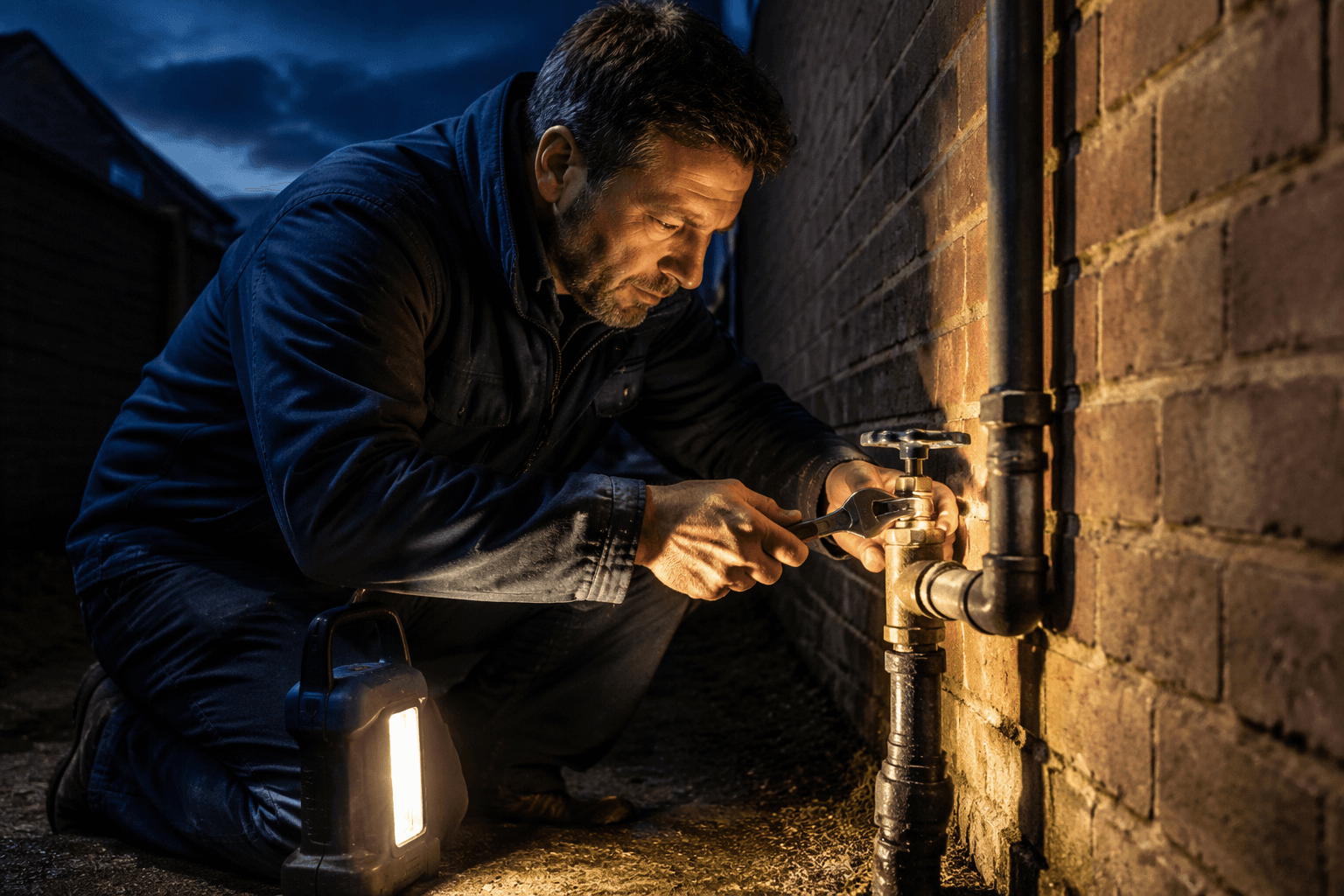
- Stop the water. Close the nearest isolation valve - or the main stopcock if the leak is upstream of every isolation. In an estate, the body corporate's communal isolation may be the only thing that stops a main-line leak; the gate code and a reachable contact are part of the call.
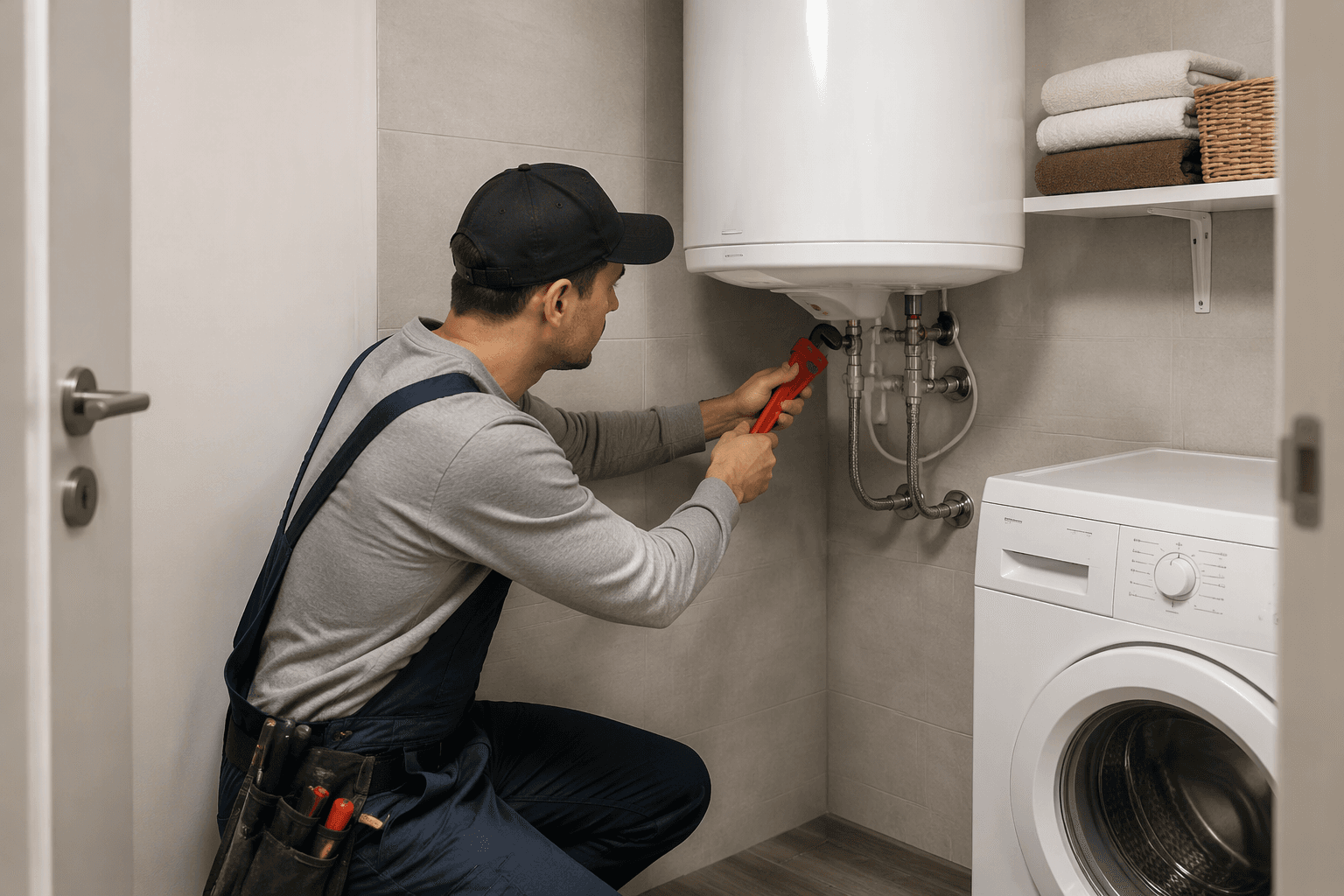
- Kill the power to anything wet. Geyser leak or no hot water: off at the distribution board (the dedicated two-pole breaker), cold feed closed where safely possible. Water plus live circuits is what turns a plumbing emergency into an electrical one.
- Protect and photograph. Move valuables, then photograph the damage before cleanup - the wet patch, the meter reading, the failed joint. Your insurer will want exactly these images, and a cleaned-up scene is an unprovable claim.
The phone call, word for word
The 2 a.m. call goes faster - and costs less - when it goes in a fixed order, and the order matters because the first two minutes of the conversation set the clock for the rest. One: the location, complete. Street and suburb first, then the estate name, unit number and gate code - operators publish their response targets for their own radius, and the time they quote you should be the time to your gate, not to the suburb. Two: the fault, in the words of what you see. "Water under the geyser", "the floor drain is rising", "no water and the meter is running" - what you see, not what you think it is; the diagnosis is the operator's job, and a wrong self-diagnosis is how the wrong trade arrives. Three: what you have already done. "The water is off at the stopcock" and "the geyser is off at the board" - that is what tells the operator the incident is contained, and contained incidents get faster treatment than active ones. Four: the meter reading and the photos. You will photograph anyway - tell them the meter shows a figure and that the photos exist, because the same statement tells the insurer's side of the story later. Five: the terms. The call-out fee, if any, and the rate that applies after diagnosis, in writing before the van leaves - the operators who will give you that number on the phone are the ones who will not renegotiate it at your door. Then it is over: the call is the booking, the response is the product, and the rest of the protocol runs itself.
Emergency rates and call-out fees
The call-out bills at R600-R1,300/hour on top of the repair itself, which prices inside the standard job ranges (a burst-pipe section, a geyser shutdown, a stopcock replacement). On the fee, Midrand practices genuinely vary: many operators advertise none; at least one publishes a flat R350 covering inspection and diagnosis - a transparent model worth asking for anywhere. Before the van leaves, confirm three things in writing: the fee (if any), whether it is deducted from the invoice, and the hourly rate that applies after diagnosis. The operators who publish their rates on the listing are the ones who will not renegotiate the number at your door at 3 a.m. - and every published range is available for cross-checking the quote that comes back. The claim side is where the preparation pays: photographs before cleanup, the itemised invoice with the emergency rate stated, and the compliance file where the failed component was a notifiable install. Insurers pay documented, compliant, contained incidents quickly - the two things that turn a claim into a dispute are almost always the cleanup before the photographs, and the installation that was never compliant.
What that night actually costs
Putting a number on it is what makes the emergency rate honest, so here is the arithmetic of the common case: a burst on a supply line at 2 a.m. The operator drives in - the drive sits under the call-out fee (the flat R350 model) or the first hour - then roughly an hour of isolation, diagnosis and the stopgap at the emergency rate, and the repair itself, the burst-pipe section or the stopcock replacement, priced inside the standard job band. One hour at the R600-R1,300 emergency rate plus a standard-range repair is the shape of that invoice, and the itemised document with the rate stated is how you check it. Two distortions change the shape. The first is a price that arrives before the fault does: at 2 a.m. the number is a promise, not a measurement, and the figure that earns your trust is the one written down after the diagnosis, not the one that opened the conversation. The second is the "while you are in there" line: in the dark, with the water still moving, is exactly the moment when extra work should produce a fresh number and your explicit go-ahead - an emergency is no excuse for a line you never agreed. Then the frame for the decision itself. The emergency rate is the price of the hour, and it is the right price when the alternative is the water spending that hour instead - a burst pipe, a flooding geyser and a rising sewer column are all costing their own money while you wait, and the rate buys the stop. It is the wrong price for a drip you can contain under a bucket; that one keeps the rate in your pocket for the night the water is actually moving.
Choosing a 24/7 operator at 2 a.m.
The directory's 24/7 filter is built for exactly this moment: only the businesses that publish round-the-clock availability, with their response targets and verbatim public reviews - the reviews that mention "arrived within the hour" at night are worth ten that mention punctuality on a Tuesday. Two practical notes. Estate access: the fastest plumber is useless if the gate will not admit them - send the code and unit number with the request, and keep the body corporate's night warden as the fallback contact if your phone is under the water. The diagnosis gap: at 2 a.m. you are booking the response, not the repair. The professional sequence is response, isolate, diagnose, quote - the repair price is agreed after the diagnosis, with your go-ahead. Anyone who quotes the repair before seeing it is selling hope. By property type the protocol is the same, with different escalation: standalone houses run exactly as written; townhouses add the shared-wall rule (water crossing into the unit below is a two-property incident - the body corporate gets a message with the same timestamp as the plumber); offices and retail run on the facility-management tree, with the operator who already holds after-hours site access as the shortlist.
What happens when they arrive
- Verify. Name, job confirmation, and - on request - the PIRB registration number; the public register at pirb.co.za works at any hour, and the check takes two minutes even at 3 a.m.
- Confirm the shutdown, then diagnose with the fault exposed. The failed joint, the burst section, the tripped circuit - and why it failed, because the cause tells you whether the repair will hold.
- The number, in writing, against the published ranges, with scope changes handled as new quotes and your explicit go-ahead.
- The repair, tested under real conditions, then the documents: itemised tax invoice (emergency rate stated), the written warranty (12 months on workmanship is the baseline), and - where the fix crossed into notifiable work - the PIRB registration and COC path confirmed. Otherwise the fix that saved you tonight can quietly void tomorrow's insurance claim.
Emergencies by season
Midrand's emergency calendar runs on the climate, and the pattern is worth knowing because it tells you which pre-check to do and when. Summer storm season - October to March, with the wettest months around January - is the drain and stormwater surge: the full flow of a mid-summer storm goes through lines that spent the dry season half-full, and the backups, the gully floods and the "it only acts up when it rains" discoveries cluster here. The calm version of that call-out is the scheduled pre-season jet, priced inside the published R500-R1,500 range. Winter - June to August, with minima around 2.5 degrees - is the geyser and frost season: hot-water demand peaks on the coldest mornings, the exposed external pipes at the meter and on the boundary take the frost stress, and the failures that the shedding season sets up tend to announce themselves on the first hard week. Load-shedding is the year-round factor underneath both: the power cycles work the element at every restoration, and the geyser call-outs that carry the emergency rate are disproportionately the units that failed in a shedding phase. The seasonal read of the protocol is the same three moves every time - stop the water, kill the power to anything wet, photograph before cleanup - with the pre-season check that matches the month: the drain jet before the storms, the geyser system check before the cold, the stopcock test in between. The season decides which failure arrives; the checklist decides what it costs.
Preventing the emergency
How this guide was researched
This guide was compiled by the directory's research team from public sources accessed on 30 September 2026 and reviewed against the standards the claims depend on: the published emergency and hourly rate benchmarks, PIRB registration and the public register, the City of Johannesburg's building-permit process, and the regional climate record behind the seasonal patterns. Every figure is a published benchmark or a provider-published rate - none were invented, and the response targets are the ones operators publish, not aspirations. The directory is independently operated, with no affiliation to any listed provider, and the pay-per-lead model means no operator can buy a position in it. If a fact here does not match what you see on the ground, the correction belongs with the sources, not with the narrative - and that is a check you can run yourself using the links below.
Sources & references
Accessed 30 September 2026. Rate figures are the published benchmarks cited in this guide.
- Published emergency call-out rates (ProCompare)
- Published standard hourly plumber rates (ProCompare)
- A Midrand operator publishing a flat call-out fee
- The PIRB public register, which works at any hour
- Midrand's climate record (Wikipedia)
- The Information Regulator - POPIA consent for quote data
Most "2 a.m. emergencies" are 2 p.m. discoveries in disguise. The annual checklist: geyser system check (element, thermostat, PRV, earthing - the geyser system check covers the load-shedding failure patterns); stopcock test (a seized stopcock converts every leak into a flood); drain flush before storm season (the calm version of the problem, priced inside the published R500-R1,500 range); and watch the meter (a slow creep with every tap off is a concealed leak billing you silently - the ~R600/hour detection visit is the cheap line item). Keep the three toolkit items in the geyser cupboard: a photo of your main isolation (the stopcock map), a bucket and towels, and a labelled geyser breaker. None of this prevents the burst; all of it determines whether the burst costs a repair or a claim. And when the real one comes, the booking is the quote form - describe the job, send it to the matched 24/7 operators, and the itemised quotes come back on one screen, free and consent-based, ready before the water is.